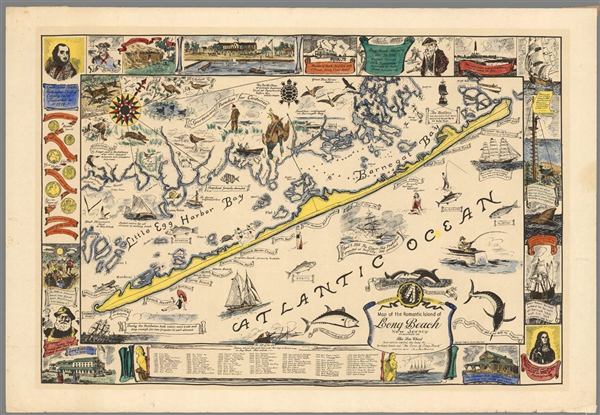
On the night of April 15, 1854, a hurricane-force snowstorm drove a 600-ton packet ship called the Powhattan onto the Barnegat Shoals, less than 100 yards from the beach at what is now Surf City, New Jersey. No one on board survived. The deaths — between 250 and 311 people, depending on the source — made it one of the deadliest maritime disasters in American history.
But the shipwreck itself was only the beginning of the story.
The Oldest Ground on the Island
To understand what happened that April, you have to understand where it happened — and what this particular strip of sand had already meant to people for nearly two centuries before the Powhattan went down.
Long before Surf City had a name, before it had a hotel or a borough council or a street grid, this was the place settlers came first. Whalers from the mainland established camps here in the late 1600s. The historical record points to the Soper and Inman families arriving around 1690, making what is now Surf City the oldest continuously settled community on Long Beach Island.
They called it the Great Swamp. The name sounds inhospitable, but it wasn't. The area was an inland freshwater oasis, dense with towering white cedar and fed by freshwater springs, an anomaly on an otherwise salt-scoured barrier island. For early settlers dependent on fresh water and timber, it was as close to a foothold as this coast offered.
The Great Swamp stood for well over a century. Then, in 1821, a hurricane swept through and erased it in a single season — toppling the cedars, flooding the freshwater pools, and leaving behind the flat sandy terrain that would define the area ever after. The following year, in 1822, someone decided to build a hotel where the swamp had been.
The Mansion of Health
The hotel was called the Mansion of Health, and it was, for its time, a genuinely ambitious structure. Three stories tall, 120 feet long, it stood near what is now West Seventh Street, with a full-length balcony running across the top floor that offered views of both the Atlantic Ocean and Barnegat Bay simultaneously. It was the first major boarding hotel on the New Jersey coast — not the first seasonal accommodation, but the first grand hotel, the kind of place that required a journey from Philadelphia or New York and justified the trouble once you arrived.
The area around it became known, informally, as Buzby's Place — a nod to one of the hotel's owners, a man named Hudson Buzby. That name stuck through the 1830s and 1840s. Eventually the hotel itself became such a landmark that the community surrounding it stopped needing any other reference: people simply called the place Old Mansion.
The Mansion of Health was a busy, functional operation: sportsmen came for the fishing and hunting, wealthy Philadelphians came for the sea air, and the hotel's manager served, officially, in a second capacity that the State of New Jersey considered just as important: wreckmaster.
The Jersey Shore in the mid-nineteenth century was known, without exaggeration, as one of the most dangerous stretches of coastline in the world. Between 1847 and 1856 alone, 64 ships wrecked along this section of coast. The stretch around Absecon Inlet had earned the name "Graveyard Inlet." Wreckmasters were state-appointed officials whose job was to take charge of a disaster scene, salvaging cargo, organizing the dead, and accounting for everything until the coroner arrived. It was an office of real responsibility, and in the area around what is now Surf City, that responsibility fell to the manager of the Mansion of Health.
In April 1854, that manager was a man named Edward Jennings.
The Storm
The Powhattan had left Le Havre, France in early March, bound for New York City. It was carrying German emigrants — families, mostly, from Prussia, Baden, Württemberg, Bavaria, and France — who had scraped together their savings for the crossing and a new life in America. The ship's manifest would later list 326 people aboard: crew and passengers combined. Every one of them would die before the month was out.
The storm that hit the New Jersey coast on the night of April 15 was described by witnesses as a hurricane-like snowstorm — a violent nor'easter that pushed walls of water and drove visibility to nothing. The Powhattan, nearing the end of a six-week voyage, was caught in it as it approached the coast.
The ship was forced steadily shoreward through the night. By early Sunday morning, April 16th, it struck the Barnegat Shoals hard — less than 100 yards from the beach at what is now Surf City. The passengers could see land. Land could not save them.
A contemporary dispatch published days later described what happened next in plain, devastating language: "One immense wave washed fully one hundred persons overboard, who were carried away down the beach by the undertow." The correspondent noted that those who made it to the waterline were already dead by the time they arrived. Captain Meyers, still on deck, called out to Jennings on shore, begging him to search for survivors among the bodies washing in. Jennings called back that there was no use — all who reached the sand were dead before they got out of the water.
The ship broke apart at 5 o'clock that Sunday afternoon. There were no survivors.
The Accounting
The bodies and wreckage washed south as far as Atlantic City over the days that followed. About 140 victims came ashore at Peahala, on Long Beach Island. They were piled on the beach outside the Mansion of Health, along with 75 to 80 packages of salvaged baggage. The scene was recorded in a newspaper dispatch that named Jennings specifically: "About 75 or 80 packages of passengers' baggage are in charge of Mr. Jennings, wreckmaster."
When the coroner arrived the following day, he examined the bodies and noticed something immediately wrong. None of the dead — not a single one — had any money on them.
This was not a small irregularity. German emigrants of that era routinely traveled with money belts worn beneath their clothing, carrying everything they owned in the world sewn into leather pouches against their skin. It was the universal practice. A ship carrying 300 emigrants should have yielded hundreds of money belts. The coroner found none.
Suspicion fell on Jennings immediately, but there was no proof. The bodies were eventually sent to Manahawkin, where they were buried in pauper's graves in the Baptist cemetery. The case seemed to die with them.
The Cedar Stump
Several months later, another storm moved through Long Beach Island. The surge and wave action scoured the sand around an old cedar stump near the Mansion of Health — a remnant, in all likelihood, of the Great Swamp that had stood before the 1821 hurricane took it. The storm stripped the sand from around the stump's roots.
Tucked among those roots were dozens of leather money belts. Every one of them had been slashed open. Every one of them was empty.
Jennings did not wait for the consequences to reach him. He left the island before any formal action could be taken, and made his way west. He is said to have been a broken man in his later years — sleepless, erratic, increasingly detached from the world around him. He died in a barroom brawl in San Francisco. The Mansion of Health, stripped of its manager and darkened by the scandal, never fully recovered. Guests began reporting strange sounds in the night — sobbing, unexplained voices, figures glimpsed on the top-floor balcony. By the early 1860s the hotel had closed. It stood vacant for years, known to locals as the Haunted Mansion, before burning to the ground in 1874.
What the Dead Built
The Powhattan disaster did not end quietly. It echoed forward in ways that are still visible today.
In the months after the wreck, a political argument that had been building for years about lighthouse coverage along the southern New Jersey coast finally broke into action. Congress had been slow to fund a lighthouse at Absecon Inlet, where the concentration of wrecks was most severe. The Powhattan, with its staggering death toll and its proximity to shore, made the case impossible to ignore any longer.
The land for Absecon Lighthouse was purchased in December 1854 — eight months after the wreck. Construction began in 1856. The light was first lit on January 15, 1857. The official report from its first ten months of operation noted that not a single ship had wrecked in its vicinity. The lighthouse still stands today in Atlantic City, at 171 feet one of the tallest in the nation, a structure that exists in part because of what happened on this beach.
In Manahawkin, the State of New Jersey erected a monument in 1904 in the Baptist cemetery where the majority of the Powhattan victims are buried. It reads: "The Unknown from the Sea" — an acknowledgment that most of those who died were never positively identified. Their names, many of them, were never confirmed. A partial passenger list eventually appeared in the New York Tribune, reconstructed from marks on luggage and fragments of correspondence. It was incomplete.
What It Means for Surf City
The Powhattan wreck is not a story that belongs to Beach Haven or Ship Bottom or Harvey Cedars. It happened here, in the water just offshore from what is now Surf City, on the beach outside the community's most significant landmark. The victims were carried to Jennings' door. The evidence of his crime was buried in the shadow of the old cedar forest that had defined this place for 150 years before him.
Surf City today is a summer town, a beach town, one of the quieter and more residential stretches on Long Beach Island. But it sits on the oldest settled ground on the island, ground that has absorbed more of this coast's history than most visitors know. The Mansion of Health is gone. The Great Swamp is gone. The Surf City Hotel stands now where the old hotel once stood, though it was eventually moved across the street to sit closer to the railroad station. Mansion Cove, at the foot of South First Street on the bay side, still carries the old name.
The money belts have never been found.
Sources and Further Reading
- Maritime Heritage Project, "The Wreck of the Powhattan" (includes contemporaneous newspaper dispatches, April 1854)
- Roger Kreuz, "The Powhatan Tragedy"
- Somerville, George B., The Lure of Long Beach, Long Beach Board of Trade, 1914
- Savadove, Larry and Margaret Thomas Buchholz, Great Storms of the Jersey Shore, Down the Shore Publishing, 1997
- HMDB Historical Marker Database, Surf City Historical Marker (erected 1989, Taxpayers Association)
- Ocean County Library, "History of Long Beach Island"
- Bay Magazine, "The Towns of Long Beach Island Old and New," 2018
- U.S. Deadly Events, Powhattan disaster entry (cross-references Berman, Sheard, Nash, and Kreuz with full citation chain)